Saturday, 18 January 2014

Bradcat's Japanese Culture Focus... Peace sign

If you've ever flicked through one of your Japanese friend's photo albums, you will have no doubt come across a photo of them holding up the "V" fingers. You see it in anime, manga and the media. One of the questions I seem to get asked a lot, is why do Japanese people (mainly the younger generations) do this in their photos?


Blogger Danny Choo showing the "V" or "Peace sign"

There seem to be many origin stories, with no definitive answer. Even some Japanese people don't even know what it means, or where it originated from. Some responses to the question I've heard range from "My parents used to do it" to simply "Everyone does this pose!" 


Some people claim it originated from an American ice skater called Janet Lynn. In the 1972 Sapporo Olympics, Lynn fell half way through her free-skate show, yet calmly dusted herself off and carried on her performance with a massive grin on her face. She ended up placing third, and became a celebrity over night with the Japanese people due to her persistence and cute grin. As Lynn was a well known peace activist, she would often be shown holding up the peace sign with her fingers in many of her photos, so it's said that Japanese people began adopting this pose in their photos too.


Janet Lynn's 1972 performance

Others claim it comes from various celebrities and advertisements in the 1970s when it became popular to pose with the peace sign and say "PEACE!" The most notable of which came from Jun Inoue in a Nikon commercial.

Bob in front of Arashiyama, Kyoto

Some say that the "V" is nothing more than a "pose enhancer" to indicate they're having a great time. Other "pose enhancers" may include a finger in the air (to indicate a good idea), fingers on the cheek dimples (to enhance cuteness), or fingers under the eyes (to indicate sadness) 

Tomomi from Scandal showing she's upset!

In all honesty, I don't believe there is any one true origin to the Japanese "V" and it will forever be just one of those things that Japanese people do in their photos. 

Just like in the west we have the "duck face"... *sigh*

What are your thoughts on the "V" sign? Do you strike this pose yourself in photos? Let me know in the comments!

Tuesday, 7 January 2014

Bradcat's Japanese Culture Focus... Japan Earthquake & Tsunami of 2011

On March 11th 2011, a magnitude 9 earthquake struck the north east coast of Japan. As if the damaged caused by the Pacific tectonic plate moving under the North American plate wasn't bad enough, the country was hit by something even more devastating; a tsunami.


Due to a gross underestimation of the tsunami, no one was fully prepared. The only previous experience the Japanese people had of tsunamis were of ones no more than a few feet high. Even though Japan had invested a lot of money into coastal protection and evacuation centres, they were not designed to withstand a tsunami of this size. Many people who took refuge in the evacuation centres were lead to a false sense of security and lost their lives to the tsunami.


I've already covered the effects of the tsunami at Fukushima on a previous blog. But I wanted to dedicate this post to how the people of Japan feel almost 3 years on. Even now, there are roughly 300,000 Japanese citizens living in temporary housing with a large amount of the £92bn relief money being misspent, the Japanese government have said. 

With much hype surrounding the 2020 olympic games being hosted in Japan, we have to ask, is this the right time? Should the government be putting money into the olympics while so many families require assistance getting their lives back? Will the olympics generate more money for Japan, which they can then use to help support the victims? Or will that be a case of too little, too late?


I have had the chance to get the opinions and accounts from some of my friends who live in Japan which I can share with you here.

"It was 2011, almost 3 years have passed since then. It was the biggest earthquake I've ever felt. I had just graduated from high school and I was 18 at the time. That day, I had a graduation party with my friends, and I was heading there on foot, when the earthquake hit. It was so scary and lasted a long time, but once the shaking had stopped, I thought nothing more of it and had fun at the party.

Then when I got back home, I saw the news bout the tsunami. I had no idea how much damage had been caused. My friends also thought that earthquake was just an earthquake. I could not believe what I saw on TV I was so surprised, and upset, that I began to cry. I thought to myself "What can I do for them? What can I do to help the relief effort?" I prayed for them everyday. I never thought I'd forget about the disaster. 

Talking about it now has made me realise that the events of the disaster had receded in my memory. I can't relate to the families affected by the tsunami as I wasn't there at the time, and I didn't lose any of my loved ones. I can only imagine the experience they went through." 
- Riho Adachi, Yokohama

"Unfortunately I do not know a lot about politics and news. The government may plan to use the profit made from the Olympics to help the revival, but 2020's a long time to wait. I think that they should help the victims as soon as possible!" 
- Natsumi Maekawa, Hirosaki

"That's really nice of you that you'll work on a blog about this subject. I was a bit excited to hear about the Tokyo Olympics but myself and many people didn't know that Japan was even nominated as one of the Olympic nominees! The government and media say that the Olympics will help rebuild the areas affected by the tsunami disaster. Perhaps the sponsor money from huge companies will help generate money for the people of the north east.

I didn't know 300,000 people are still homeless, I feel bad for not knowing that. It's been 3 years since the tsunami and some areas are back to normal, which often makes me forget about the disaster. However I must never forget, and I will have to visit the north east again soon."

- Nami Inoue, Osaka


"That's an awful fact. The misspent money could've helped the victims of the tsunami for years to come. As for the Olympics, we can expect economic effects and the government should have more money to help the victims. However, that's a long way off, and it's a fact that many people are suffering right now from the aftermath. So I want the government to use the money effectively for helping those people."
- Naoko Okamoto, Osaka


"Sean! First of all, thank you very much for sending your love to Japan. We really appreciate you and your encouragement from all over the world! I also would like to research how the situation has been changing in Fukushima after the tsunami."
- Yasuko Ohashi, Tokyo


You can watch the breathtaking documentary called "Japan's Tsunami: Caught on Camera" which inspired this blog post, right here:
Japan's Tsunami: Caught on Camera captures the impact of the earthquake and tsunami that devastated Japan in March 2011, using amateur footage filmed by those caught up in the disaster.

What are your thoughts on the disaster? What actions would you like the Japanese government to take? Do you think the 2020 Olympics will help Japan? Please leave your comments below, I'd love to hear all of your opinions.

A huge thank you to my Japanese friends for sharing their experiences of the tsunami with me, and allowing me to share them with you all.

Saturday, 4 January 2014

Bradcat's Japanese Culture Focus... Fukubukuro

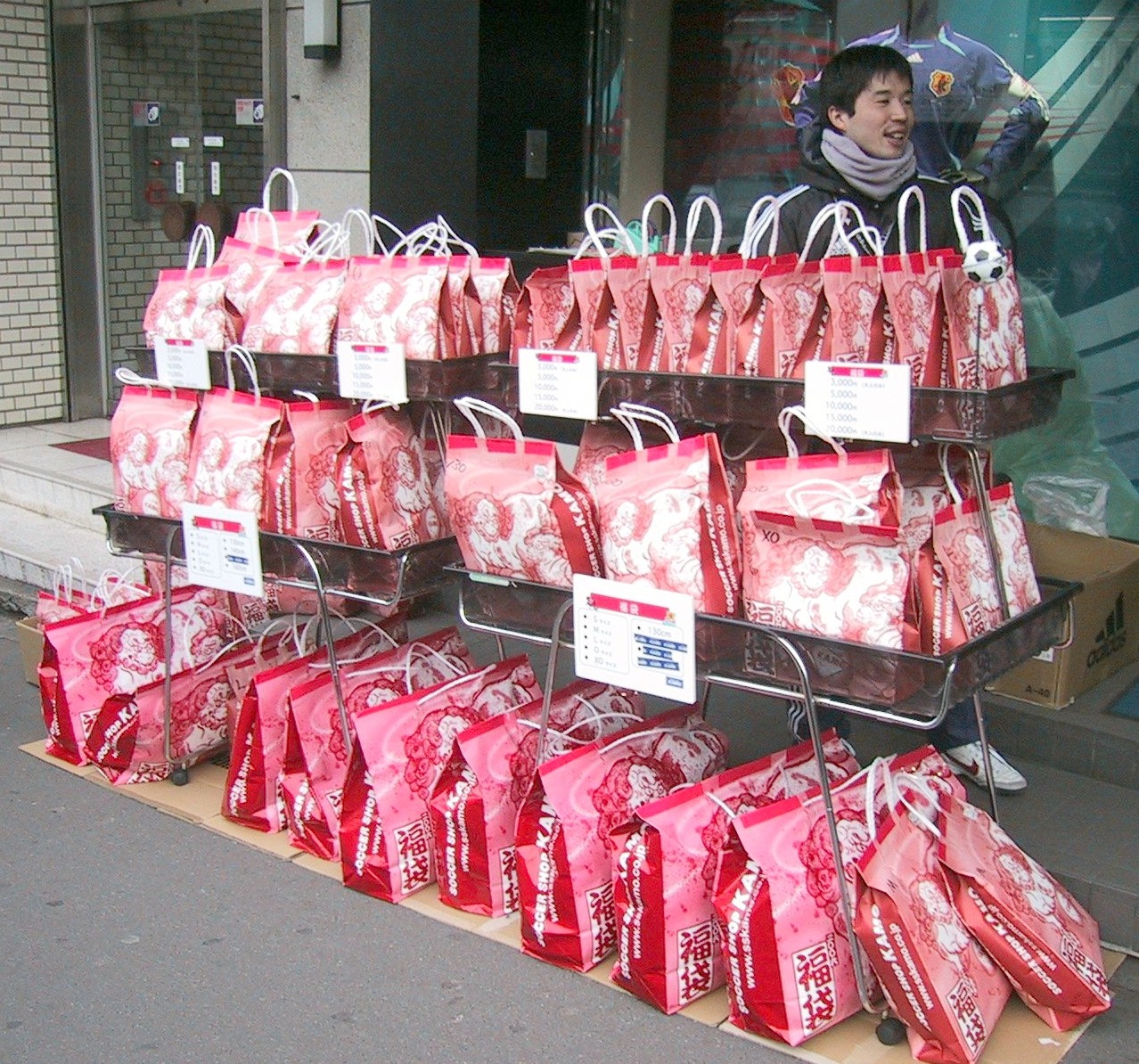
The new year in the UK usually brings the highly anticipated January sales, where retailers drop the prices of their extra stock they acquired over Christmas. In Japan, things are a little different. While they still have clearance sales, they offer customers something called "Fukubukuro" which are essentially, lucky bags. The term is formed from Japanese fuku (福, good fortune) and fukuro (袋, bag)


Fukubukuro were introduced during the Meji era (Late 19th century) and have become a Japanese tradition ever since. They can range drastically in price depending on the retailer. While the contents are hidden, it's usually understood that the goodies inside are worth more than the sale price. 

There were reports this year that one store was offering a one-week visit to Brazil during the soccer World Cup! While Apple, not to be out done, were shipping their fukubukuro with iPads, iPods and iPhones. On the other end of the scale, some stores even advertise "utsubukuro" which are "depressing bags" sold for low prices, usually between  ¥500 - ¥1,000


If the UK offered a similar concept, would you buy one? What would you like to find inside your fukubukuro? Do you live in Japan, and bought one for yourself? If so, what did you find? Please leave a comment below!

Photo credit 1
Photo credit 2

Friday, 27 December 2013

Bradcat's Japanese Word of the Week... Arigatou

Bradcat's Japanese phrase/word of the week is "Arigatou" (ありがとう) which means "Thank you"

You've probably heard this phrase a million times in TV shows, movies, and songs. 
However most people pronounce it incorrectly. Similar to "Konnichiwa" where the emphasis is on the "N" being held which a lot of people miss, with "Arigatou" the focus is on the "R" which is more of a soft "L" sound. Try touching the roof of your mouth ever so slightly as you pronounce the "R" to make it sound a lot more natural.

There are also words you can add to change the meaning of the "thank you":

Domo arigato (どうもありがとう) Thanks a lot.

Arigatou gozaimashita (ありがとうございました) To say thanks for something that's been done for you.


Arigatou gozaimasu (ありがとうございます。) A very formal way of saying thank you.


So let's say for example you're in the middle of a zombie apocalypse in Japan, and someone smashes a zombie's head, just as it was about to take a bite out of your arm. You could turn round and say...

"Sore o koroshite kurete arigatou gozaimashita" which means "Thank you for killing it!"


Friday, 13 December 2013

Bradcat's J-Music Focus... Hanato Chiruran

I'm always on the look out for new Japanese music (After all, there's only so much Scandal one man can listen to) which is how I stumbled across a podcast called "It Came From Japan", an independent outfit ran by Daniel Robson. I listen to the podcast on a regular basis, and really enjoy all the bands Daniel suggests. However none of them really jumped out at me like Hanato Chiruran did.


Hanato Chiruran

I've always been a fan of bands with disjointed guitar riffs and jazz beats. The first musicians that jump to mind are Acoustic Ladyland and Giraffes? Giraffes! which is where I think Hanato Chiruran would fit in the west.

Hanato Chiruran are a Japanese rock band formed in Tokyo in 2008. They have had collaborations with many other musicians, including hip-hop artists, but over time they have changed their style to classic rock and roll. Releasing their first album "Dirty and Beauty" in 2009, they followed this up in 2010 with "Bulldozer" where they were picked up by a management team and began touring in Europe in 2011 and 2012 in places such as Germany, France, and Italy.

It's hard to describe Hanato Chiruran's unique sound without hearing it for yourself. Lead vocalist Yumiho has a beautifully haunting voice, combined with John Frusciante style guitar from Kokeshi, funky and lightning precise bass tones from Karuta, and indie trip-hop beats from Rossi. Altogether they give an amazingly epic sound for an indie band.


Hanato Chiruran - The Game

The track which caught my attention from the "It Came From Japan" podcast was "The Game". I sent a tweet to Daniel asking if I could download the track from iTunes. He then messaged the band directly, which put me in contact with Yumiho. She was kind enough to explain that they had no digital version, only a CD, but she would send me a CD in the post!


"To Sean, Enjoy our CD, Thank you!" - A message from Hanato Chiruran / Yumiho


Hanato Chiruran - Bulldozer

I received the CD in just a few days and immediately imported it to my iTunes and it's been sat on repeat for days now. There are segments of each track which are reminiscent of some of my favourite tracks by western artists including Bloc Party, Red Hot Chilli Peppers, and The XX. "The Game" is still my favourite track, just for it's haunting opening lyrics where Yumiho asks "Did we shoot a dice when we walked in for the first time?" as we realise this is a romantic song full of regret, but no sooner do we fall in love with her soft traditional Japanese vocals, that the rest of the band explode into action into a fast paced five minute belter. The video above doesn't really do the track justice due to the recording quality of the video camera, but believe me, it sounds fantastic.

I'll wrap up by leaving you with another track from the album, it's called "JUMP"

Hanato Chiruran - JUMP

For more information on Hanato Chiruran, you can find their official links here:
Hanato Chiruran official website

Hanato Chiruran on Facebook
Hanato Chiruran on Twitter

Don't forget to check out "It Came From Japan" too:
It Came From Japan official website

It Came From Japan on Twitter